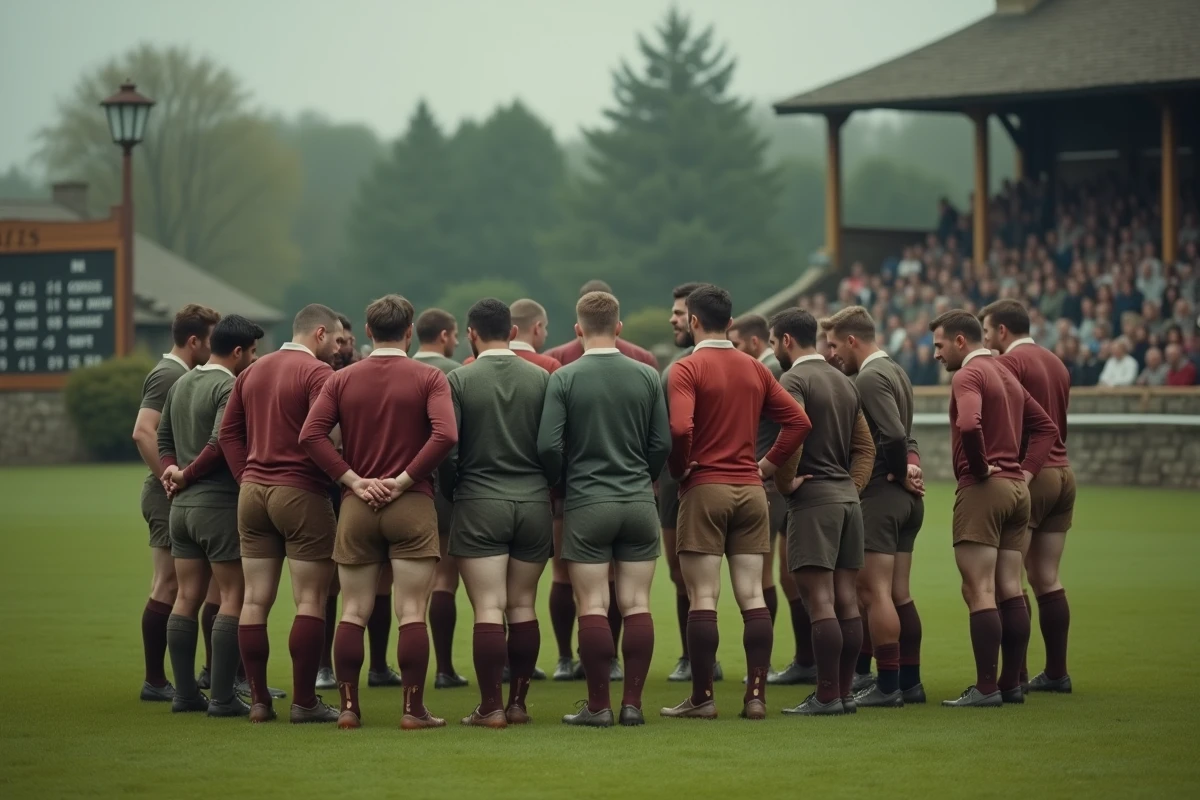
During a rugby union match, the break between the two halves today lasts fifteen minutes. This duration may seem obvious, but it hasn’t always existed. The first matches organized in England in the 19th century only allowed for a few minutes to change sides and catch one’s breath. Understanding how this break has lengthened also means understanding how rugby transitioned from a school pastime to a professional sport broadcast worldwide.
Medical protocol and halftime: what the fifteen minutes really conceal
Have you ever noticed that at halftime of a test match, some players disappear into a corridor instead of heading to the locker room? Since the introduction of the HIA (Head Injury Assessment) protocol by World Rugby in 2012, and its reinforcement after 2016, halftime also serves as a medical evaluation space. A player suspected of a concussion undergoes a series of cognitive and physical tests while their teammates hydrate and adjust tactics.
The regulations have not formally extended the break, however. Instead, the actual use of these fifteen minutes has changed. The medical staff now has video feedback to identify a head injury that occurred during play. This review takes time and often occurs during halftime rather than during the match to avoid penalizing the team.
Before these protocols, the break was used for physical recovery and coach instructions. Today, it incorporates a health dimension that amateur rugby in the 1970s could not have imagined. The evolution of the halftime duration in rugby through the ages reflects this shift towards player protection as much as towards performance.

From five to fifteen minutes: key stages of lengthening
In the beginning, rugby matches in England did not have a fixed halftime duration. Teams would change sides and the game would resume almost immediately. Then, with the structuring of rules at the end of the 19th century, a break of a few minutes was formalized.
The short break of the early days
The first codifications allowed for about five minutes. This was sufficient for a still amateur sport, played on muddy fields by players who followed no physical preparation program. Halftime was for catching one’s breath, not for analysis.
The gradual lengthening in the 20th century
As international matches multiplied (France, England, Wales, New Zealand), governing bodies extended the break. The reasons were both the increasing physical demands and the need to give teams a longer time for tactical discussions.
The fifteen-minute duration became established internationally under the auspices of the IRB (now World Rugby). This standard remains in effect for both men’s and women’s rugby union at the highest level.
Rugby sevens, women’s rugby: very different halftimes
Rugby union is not the only format. And the duration of halftime varies significantly from one discipline to another, something many spectators are unaware of.
- Rugby sevens: halftime lasts only one minute during pool phases, sometimes two in the final. The format is designed to allow matches to flow in a condensed tournament, often broadcast continuously on television.
- Elite women’s rugby: the break has gradually been aligned with that of men’s competitions since the 2000s. Previously, some formats allowed for shorter breaks for scheduling and logistical reasons.
- Youth categories: national federations adapt the halftime duration according to the players’ ages, with sometimes reduced breaks for shorter matches.
This diversity shows that halftime is not a fixed parameter but a variable adjusted to the competition format. Rugby sevens, designed for fast-paced entertainment, cannot afford a fifteen-minute break between each match in a tournament.

TV rights and professionalization: halftime as a commercial product
Why does halftime in professional rugby last exactly fifteen minutes and not ten or twenty? The answer is partly sporting, partly economic.
With the professionalization of rugby in the 1990s, broadcasters gained considerable influence in the organization of competitions. Halftime became a commercial slot. Channels insert analyses, summaries, and ads. Fifteen minutes provide a format compatible with television ad breaks without being too long for spectators in the stands.
In football, halftime also lasts fifteen minutes, but the referee strictly signals the resumption on time. In rugby, the halftime clock is managed more flexibly by the referee, who can extend it for a few moments to allow teams to return to the field.
This convergence between sporting logic and television constraints explains why the current duration seems stable. Broadcasters have no interest in shortening it, and players have no reason to request a longer break.
What halftime reveals about the evolution of rugby
The break between the two halves of a rugby match is not a trivial detail. It encapsulates several major transformations in the sport:
- The transition from an amateur game to a professional sport structured around physical performance.
- The rise of medical protocols, particularly regarding concussions.
- The influence of TV rights and commercial imperatives on the format of competitions.
- The adaptation of rules to different formats (XV, sevens, women’s rugby, youth categories).
Halftime is a mirror of what rugby expects from its players at each era. Five minutes were sufficient when the match was a pastime among amateurs. Fifteen minutes have become the minimum when it became necessary to treat, analyze, and sell.
The next adjustment may come from advances in real-time medical monitoring or a new competition format yet to be invented. The only certainty is that this break will continue to adapt to the demands of the game and those who watch it.