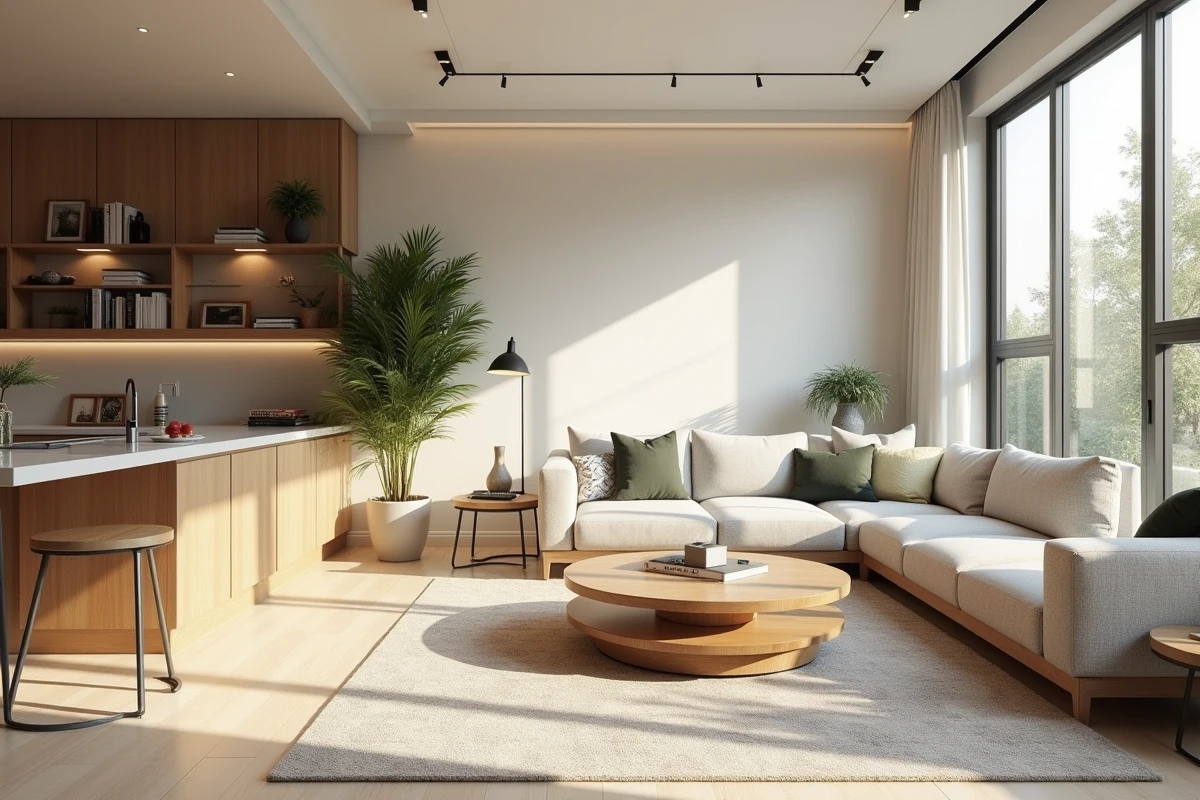
A couple with a young child visits a 55 m² T3 in a new development. On the plan, everything seems coherent. On-site, the central hallway eats up usable space, the bedrooms barely accommodate a double bed, and the open kitchen offers less storage than expected. The advertised area of a T3 tells only part of the story: it’s the layout that determines whether it’s comfortable to live in or if you bump into things.
To learn everything about the area of a T3, you need to go beyond just counting square meters and look at how the rooms connect with each other.
Inverted L layout or central hallway: the layout that changes everything in a T3
Field feedback converges: an inverted L T3 sells significantly faster in large urban areas than a classic central hallway plan. The reason is simple. The inverted L places the open kitchen next to the living room, then isolates the bedrooms in a separate wing, often accessible via a small hallway.
This layout creates two distinct zones (common living and night) without consuming space for circulation. In contrast, the central hallway distributes the rooms on either side, generating several square meters of pure passage that cannot be used for furniture or storage.

When visiting a T3, the first thing to check is not the total area but the ratio between actual living space and circulation space. A modestly sized apartment with a compact layout will be more comfortable than a larger home divided by a long hallway.
What brochure plans don’t show
Developer plans are often presented without furniture or with undersized furniture. It is recommended to come for a visit with the dimensions of your sofa, table, and bed. A living room that appears spacious on the plan may turn out to be too narrow to accommodate both a dining area and a functional living space.
Old or new T3: the gap in actual living area
Buildings constructed before 1970 typically offer an average living area that is ten to fifteen percent larger than new T3s, with the same number of rooms. The reasons are multiple: thicker load-bearing walls (but originally larger rooms), more generous ceiling heights, and the absence of internal insulation constraints that eat up centimeters on each wall.
RE2020 has strengthened thermal requirements for new developments since January 2022. Buffer spaces, insulation thickness, and technical ducts mechanically reduce usable space. In return, thermal and acoustic comfort improves. This is a trade-off that needs to be clearly considered before purchase.
- Old T3 (before 1970): generous spaces, but energy renovation work often necessary, impacting the overall budget
- T3 from the 1980s to 2000s: intermediate spaces, sometimes dated plans with closed kitchens and bathrooms without windows
- New T3 (post-RE2020): optimized plans and high energy performance, but more compact living areas at a higher price per square meter
Feedback varies on this point: some buyers prefer to renovate a spacious old property, while others prioritize the immediate comfort of new builds. The key is to compare the Carrez areas, not the advertised commercial areas.
Designing a T3 for active seniors: PMR accessibility without sacrificing family space
This is a growing use case that most design guides overlook. Active retirees moving from a house to a T3 in the city have specific needs: barrier-free circulation, adapted bathroom, and bright living area, while still keeping a guest room for children and grandchildren.
PMR accessibility standards require minimum passage widths and turning areas in the bathroom. In practical terms, this means that a PMR bathroom takes up more space than a standard bathroom. If the T3 is less than 60 m², installing a walk-in shower with maneuvering space reduces the available area for the rest of the home.
Concrete adjustments that work
- Replace the bathtub with a walk-in shower with a foldable seat: frees up floor space while meeting accessibility criteria
- Install sliding pocket doors on the bedrooms and bathroom: immediate gain in clearance space, and easier wheelchair access
- Opt for a linear kitchen rather than a U-shaped one: frees up wide circulation space in front of the worktop, compatible with a walker or wheelchair
- Plan for outlets and switches at an appropriate height (between 40 cm and 130 cm) from the construction phase to avoid redoing the walls later
This type of design is not reserved for people with reduced mobility. A T3 designed to be accessible from the start remains perfectly functional for a family: wide circulation spaces also make life easier with a stroller or a child’s bike in the entrance.
Storage and furniture in a T3: the trade-offs that really matter
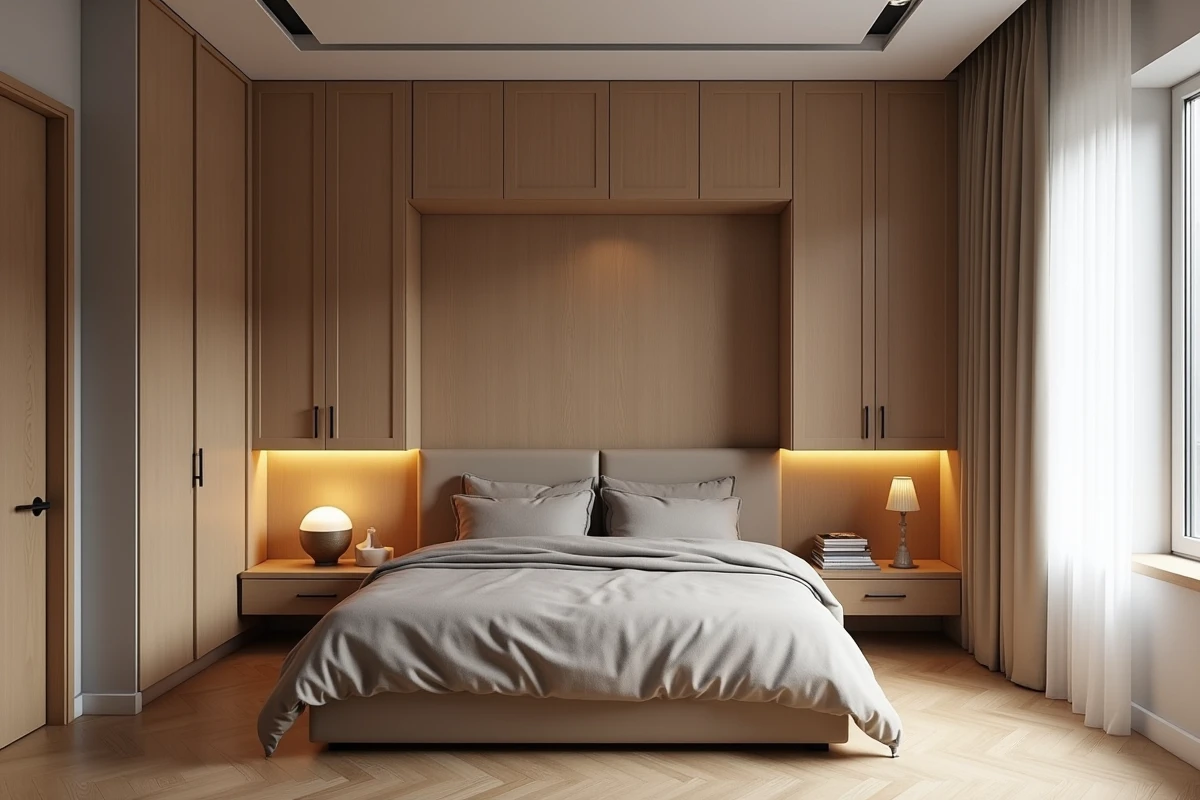
Storage is the most underestimated aspect in a T3. You plan for the bed, sofa, table, but rarely the storage volume needed for daily life. A T3 without built-in closets quickly loses comfort: belongings overflow, and rooms seem smaller.
The first operational reflex is to utilize the full height of the ceiling. High storage in the entrance, shelves above doors, a bed with integrated drawers in the child’s room: these solutions do not consume any floor space.
The second trade-off concerns the kitchen. An integrated dining area in the worktop (like a bar or peninsula) replaces the classic table and frees up space in the living room. This choice works particularly well in T3s with open kitchens, where the boundary between preparation space and living space blurs.
Choosing a T3 suitable for your situation relies less on the raw area than on the quality of the plan, the fit between the layout and actual lifestyle, and the ability to anticipate medium-term needs. A well-distributed apartment on a modest area will always offer more comfort than a spacious but poorly designed home.