The sewing machine market has never been so fragmented. Between historic Japanese brands, European manufacturers repositioned in the high-end segment, and the arrival of Chinese manufacturers in the semi-industrial segment, choosing a sewing machine relies on criteria that go beyond the mere notoriety of the logo on the lid.
Refurbished sewing machines versus new entry-level models
Refurbished second-hand sewing machines represent a blind spot in classic comparisons. A mechanical machine from the 1990s or 2000s, serviced by a specialized repair technician, often features a metal chassis and gears that are more robust than those of new models sold for under 200 euros.
Field reports vary on this point depending on the brands: older cast iron Singers or Pfaffs with integrated feed (IDT system) maintain a fabric feeding precision that current entry-level models, often equipped with plastic parts, struggle to replicate. For beginners who want to sew various fabrics (jersey, heavy canvas, linen), a well-inspected refurbished model protects just as well as a new one.
The savings are tangible: the budget recovered from the purchase of the machine finances the purchase of suitable presser feet or quality threads, two areas often overlooked by beginners. To learn everything about sewing machine brands, one should also look at these second-life channels that are becoming more structured.
Fabric feeding and stitch types: the technical criteria that differentiate brands
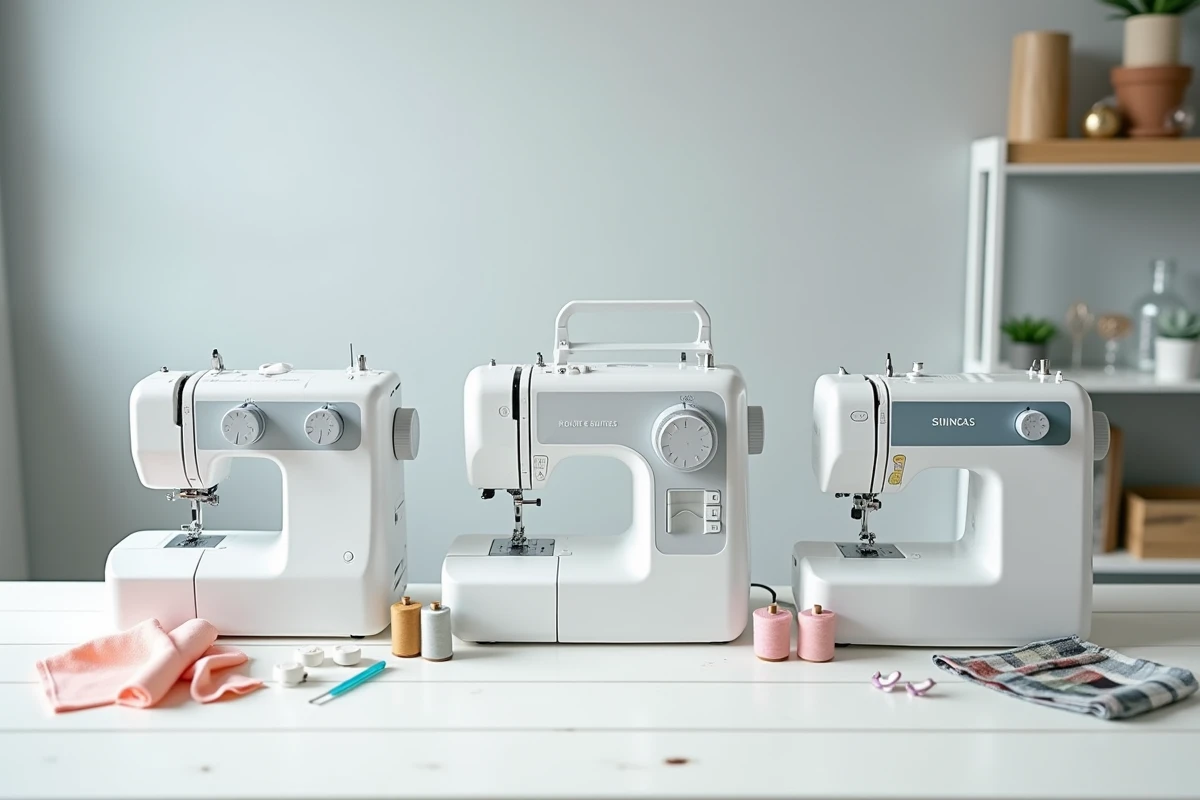
The feeding system is the primary technical differentiator between brands. Pfaff stands out with its integrated dual feed IDT, which synchronizes the feed dogs and presser foot to pull the fabric from both the top and bottom simultaneously. This mechanism reduces slipping of layers, a recurring issue with stretchy fabrics or thick overlays.
Brother and Janome offer classic feeding systems (only feed dogs) on their mid-range models, compensated by specific presser feet sold as accessories. The difference is especially felt on jersey and faux leather.
Regarding stitch types, electronic machines display catalogs of several dozen stitches. In practice, the majority of common projects use fewer than ten stitches: straight, zigzag, automatic buttonhole, stretch stitch, and a few decorative stitches. The number of stitches does not reflect sewing quality. A consistent straight stitch over multiple layers of fabric says more about the machine than a catalog of 200 decorative stitches.
- The straight stitch and zigzag cover the majority of domestic sewing needs, from cotton to upholstery fabric.
- The one-step automatic buttonhole (offered by Brother, Singer, Janome) simplifies a technical action that intimidates beginners.
- Stretch stitches are essential for sewing jersey without an overlocker, a criterion to check before purchase.
Connected sewing machines and eco-design directive: what changes in 2025
Since 2025, Brother and Janome have integrated connected features (IoT) into certain models, allowing for pattern customization via mobile applications. This trend primarily targets intermediate and advanced sewists who utilize embroidery or custom stitches.
On the regulatory front, the European ErP 2025 directive (EU Directive 2025/432) mandates a reduction in energy consumption for electronic sewing machines, particularly in standby mode. Pfaff models are among those that show some of the lowest standby consumption, a criterion that is invisible at the time of purchase but impacts the electricity bill in the long term.
The available data does not yet allow for measuring the concrete impact of this directive on retail prices in France, but it pushes manufacturers to rethink the embedded electronics of their mid-range offerings.
Post-warranty maintenance and access to spare parts by brand
Choosing a sewing machine brand also means choosing a maintenance ecosystem. Users report a trend towards lower repair costs for Brother Innov-is due to more accessible spare parts in 2026. In contrast, Janome machines remain more proprietary regarding certain components, complicating repairs outside of authorized networks.
Pfaff and Bernina have networks of specialized repair technicians in Europe, but the supply times for parts vary by model. For Chinese brands like Juki or Jack, which are gaining ground in Europe with affordable semi-industrial machines, access to parts is improving but remains uneven across countries.
- Brother offers the widest online spare parts catalog, with replacement tutorials accessible to individuals.
- Pfaff and Bernina rely on a network of authorized dealer-repairers, providing more personalized follow-up but at higher intervention costs.
- Juki and Jack offer robust machines at reasonable prices, but their after-sales service network in Europe is still being structured.
Mechanical or electronic: which type of sewing machine for which use
The mechanical machine remains the most reliable choice for those who want to sew without relying on electronics. Fewer components mean fewer potential breakdowns, and manual adjustments (thread tension, stitch length) develop a concrete understanding of how the machine works.
The electronic machine offers the precision of digital adjustment, memory of settings, and access to automatic stitches. For technical or stretchy fabrics, electronics provide superior consistency. The Brother FS and Janome Skyline ranges illustrate this positioning, with motors capable of automatically adjusting sewing speed to the thickness of the fabric.
The choice between mechanical and electronic is not just about budget. It depends on the type of projects envisioned and the tolerance for technical complexity. A sewist primarily working with cotton and linen does not have the same needs as another who alternates between jersey, faux leather, and upholstery fabric.
The sewing machine market pushes for the purchase of increasingly equipped models, but the reliability of the feeding system, access to spare parts, and compatibility with the fabrics being worked on remain the three criteria that make a difference on a daily basis, well beyond the number of stitches or connectivity.